
Introducing Our AI Appropriate Use Framework
UPRATE™ is 8-Bit Spark’s six-question litmus test for deciding whether AI belongs in your solution, and how to build it responsibly when it does.
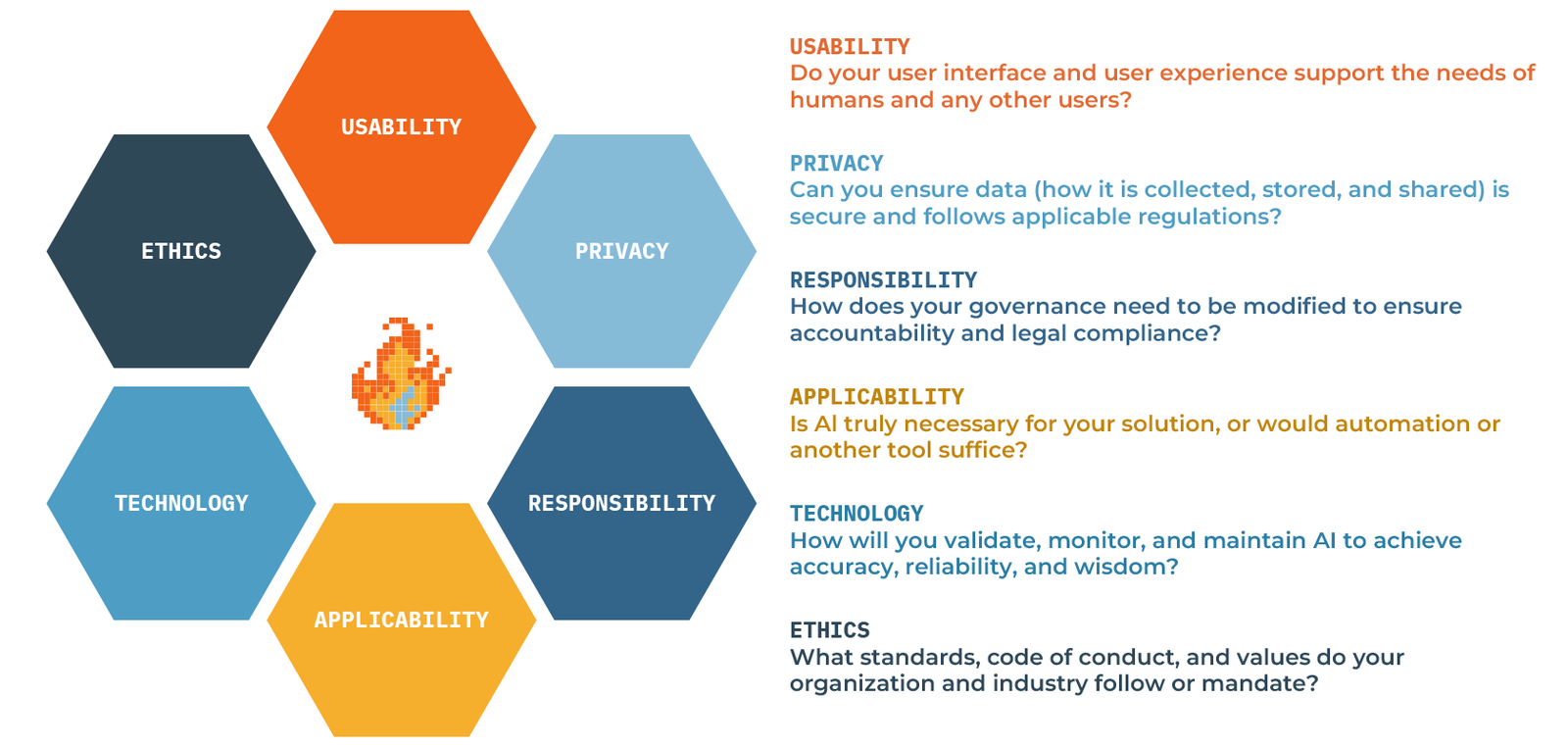
Does your artificial intelligence (AI) roadmap start with “where can we use it” rather than “what problem are we trying to solve”? Most people come into conversations about AI assuming that it absolutely must be used, that if they are not immediately integrating it into their product and service offerings or their back-office functions they will be left behind. Like most technologies, it is not that simple. It is just as important to recognize when machine learning (ML) and AI should not be used as when they should be used.
What is UPRATE?
UPRATE is 8-Bit Spark’s AI Appropriate Use Framework. It can be used as a litmus test to not only help you determine if AI technologies should be used, but also help shape your ML and AI solution architectures.
We invite you to ask yourself the following questions:
- Usability — Do your user interface and user experience support the needs of humans and any other users?
- Privacy — Can you ensure data (how it is collected, stored, and shared) is secure and follows applicable regulations?
- Responsibility — How does your governance need to be modified to ensure accountability and legal compliance?
- Applicability — Is AI truly necessary for your solution, or would automation or another tool suffice?
- Technology — How will you validate, monitor, and maintain AI to achieve accuracy, reliability, and wisdom?
- Ethics — What standards, code of conduct, and values do your organization and industry follow or mandate?
Why did we create our own framework?
The considerations described in UPRATE are concepts we have both been discussing and evaluating professionally for decades. It was instinctive to incorporate them into our earliest conversations about AI. Over time, as we began to hone our thoughts into a more cohesive set of recommendations, the people we spoke with encouraged us to formalize it into our own framework.
Before we did that, we did a more thorough search for other existing frameworks. We are not the first people to urge careful judgement about whether and how to use AI. An article, ‘When Not To Use AI’, in MIT Sloan Management Review describes a viewpoint closely aligned with ours. Though it gives some great examples about when not to use AI, it is not a framework. Cochrane jointly created the RAISE (Responsible use of AI in evidence SynthEsis) framework to guide the ethical and transparent use of AI across the evidence synthesis ecosystem. Other prestigious organizations have published their own frameworks, notably Harvard DCE, NIST, and Microsoft. The existing frameworks we found are mostly risk management for already-greenlit AI initiatives, sector-specific, or principles without operational questions.
UPRATE’s distinction is that it is a lightweight, technology-agnostic, pre-decision litmus test that includes the question most frameworks skip, “should this even be AI?”
How we have used UPRATE
We have been sharing UPRATE (and its informal precursors) with many of our clients and acquaintances for over a year. It has aided conversations ranging from brand-new AI-native products and services to digital transformation of existing companies’ business operating models.
One of those discussions was with a professional services company that wanted to create a standalone AI offering for their clients. As we walked through the framework, the concept that proved most critical was RESPONSIBILITY. Specifically, in their line of work, it would have been extremely difficult (if not impossible) to guarantee that an unsupervised externally-facing AI solution would comply with all their legal and insurance requirements. As a result, they decided to put that initiative on hold and instead investigate ways that AI-assisted technologies could empower their team members to produce offerings more efficiently.
Another discussion was with an entertainment company that was feeling pressured from within to integrate AI into their back-office processes. When we walked together through the framework, we helped them get to the why behind the vast majority of those internal requests. It turned out that the crux of the issue was related to existing tools and workflows. The proposed AI solutions failed the APPLICABILITY consideration since there were a number of ways that workflows could be improved by streamlining the number of tools and automating some of the more onerous manual processes.
A third discussion was with founders of a healthcare company with an AI-native business model and a working prototype they needed to evolve into a minimum viable product. We used the framework to help them analyze their proposed solution architecture. It, and another framework we use for nonfunctional requirements (which we will cover in a future article), helped catch a number of issues in and between components. Addressing these TECHNOLOGY issues at the design stage was much easier and cheaper than if they had been caught in later stages of development or quality assurance testing.
How can you use UPRATE?
If you are wondering how to incorporate AI, or in the midst of one of your initial implementations, we recommend you and your team take some time to review each element of UPRATE one-by-one (usability, privacy, responsibility, applicability, technology, and ethics). It works for startups, mid-sized companies, large corporations, and government agencies.
Though the questions we have included in our framework were deliberately designed to be technology-, solution-, and industry-agnostic, you can build on them to tailor any or all topics to your specific needs. For example:
- Healthcare
Enhance questions to reflect the healthcare industry’s highly regulated environment, requirements for securing Personally Identifiable Information (PII) and Protected Health Information (PHI), and potentially complex payment models. - B2B + B2C Product/Service Companies
Enhance questions to best reflect the needs of your offering and company (some might need more focus on reducing time to market or protecting intellectual property, while others might need more focus on preserving quality and reliability or supporting accountability and regulations). - Entertainment
Enhance questions to reflect the entertainment industry’s unique cultural and artistic needs (where expression and integrity can sometimes be at odds with financing, monetization, and return on investment) as well as requirements for intellectual property.
Frameworks make it easier to think through complex problems and solutions more systematically. What do you learn when you apply the six elements of UPRATE to the AI initiative furthest along on your roadmap?
We welcome your questions and feedback, and enjoy conversations with new people. Reach us at team@8bitspark.com.